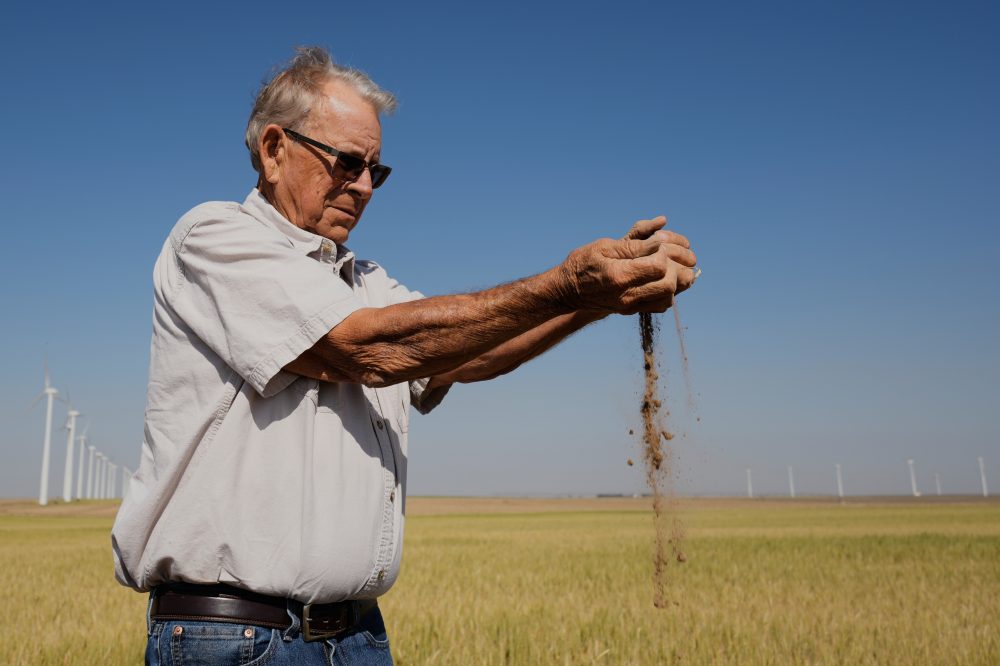

MONTEZUMA, Kan. — For decades, Orville Williams has successfully cultivated wheat across his 2,600-acre operation in Montezuma, Kansas, maintaining productive harvests since his teenage years.
While he’s weathered economic hardships during the 1980s and various drought periods that affected his yields over the years, this growing season presents unprecedented challenges.
“All in all, it’s not going to be a good year,” Williams, 76, explained.
Extreme drought conditions and above-normal temperatures, combined with sudden temperature drops, have devastated much of the United States this year, particularly affecting Plains states. These harsh conditions have accelerated the spread of wheat streak mosaic virus and barley yellow dwarf virus, severely limiting crop potential. Rising expenses for fertilizer, diesel fuel, and tariffs have created additional financial strain for experienced wheat producers.
“It’s kind of a double whamma,” Williams noted.
Production forecasts reveal the severity of the crisis. Agricultural producers face their lowest wheat output since 1972, with the U.S. Department of Agriculture projecting 1.56 billion bushels this year, declining to 1.05 billion bushels in 2025. This situation particularly impacts Kansas, which ranks among America’s leading wheat-producing states.
Analysis of USDA information indicates that Kansas wheat conditions have reached such poor levels in only five instances over the past four decades, with 58% of crops classified as “poor” or “very poor” as of May 17. Field conditions haven’t been this deteriorated since a devastating drought in 2023.
“It’s very tough conditions that growers are faced with right now,” explained Kansas State agronomist Romulo Lolloto. He emphasized the consumer impact, “whether it is through going to a bakery and having higher bread prices, or whether it’s through losing some of the international market out there for the U.S.”
The challenging season has forced numerous wheat producers to file crop insurance claims or explore alternative crops to manage financial uncertainty.
Williams achieved nearly 100 bushels per acre with irrigation last season, but expects only 30 to 40 bushels this year. He divides his wheat production between irrigated fields and dryland farming — which relies on natural rainfall and soil moisture — where he anticipates just 10 to 15 bushels per acre.
Williams and fellow producers acknowledge they’ll experience financial losses this season. “I guess my attitude is: Stay the course. Don’t make any new purchases,” he stated. “And forget your wants and just do your needs.”
Climate change, resulting from burning fossil fuels, has increasingly complicated crop production over recent years, and wheat faces similar challenges. Multiple wheat producers described intensifying weather extremes this season, including winter’s unusual heat, late freezing temperatures, and persistent rainfall shortages.
Meanwhile, the United States has ceded market share in global wheat trade to Russia and the European Union; domestic wheat acreage has declined over recent years due to multiple factors, according to USDA meteorologist Brad Rippey.
“There’s certainly a downward trend for wheat in the Great Plains and elsewhere in the U.S. based on a number of factors, and certainly the weather challenges over the last couple of decades have been a big part of that,” Rippey observed.
Nevertheless, wheat remains the country’s third-largest field crop by planted area, production volume, and farm revenue, following corn and soybeans, per USDA data. The United States ranks among the world’s top wheat producers by volume annually and serves as a major crop exporter.
Thousands of American farmers depend on wheat for their primary income — and circumstances beyond their influence have complicated their operations.
Dry weather accelerated crop development, according to USDA records, which doesn’t indicate positive harvest quality.
By early May’s first complete week, 86% of Kansas wheat crops had developed seed heads, compared to the typical 61% during the same period over the previous decade. While plants are “genetically programmed” to form heads before dying, Rippey explained, premature development often results in inferior quality.
Farmers planted only 32.4 million acres (13.1 million hectares) of wheat this year initially, with harvested acreage reaching just 22 million, creating an abandonment rate slightly above 32% of this year’s wheat crop, based on USDA projections.
Excluding the 2022-2023 cycle, only a few other historical periods have seen higher U.S. winter wheat abandonment rates, Rippey pointed out.
In Kansas, approximately 17% of the crop faces abandonment this year.
“Rain makes grain,” stated Mike Nickelson, who grows wheat and corn in western Kansas. “That’s the whole key. We can do the very best we can do and then if we don’t get the rain, then it makes it pretty tough.”
Weather forecasters predict a significant El Nino pattern, a natural cyclical phenomenon where equatorial Pacific waters warm and modify global weather systems, including precipitation. Since this typically brings above-normal summer temperatures to the United States, drought relief may not arrive for months.
“It seems like we’re the ones out trying to feed the world and we’re the ones suffering the most,” Nickelson, 60, reflected. “My son is here farming with me and I’d really like to transition him to help take over the farm. I’m like, really, do I want him to have to do this? I mean, it’s a great life, but man, right now it’s just tough.”
The conflict in Iran has driven fuel costs higher. Williams, the Montezuma producer, travels 150 to 200 miles (240 to 320 kilometers) daily, with diesel prices increasing nearly $2 per gallon compared to last year.
Expenses for seeds, fertilizer, and other inputs continue climbing rapidly. Some producers purchased fertilizer early for this season but remain concerned about next year’s costs. Farmers continue dealing with consequences from the Trump administration’s volatile trade policies.
Nickelson reported that urea, an agricultural fertilizer, previously cost $400 per ton. He currently pays between $600 and $700 per ton. “You hope to break even, but I’m not sure we’re gonna do that,” he said.
For Ben Palen, a fifth-generation farmer and agricultural consultant, viable solutions remain elusive, with minimal relief available.
Crop insurance coverage for losses provides limited compensation. The Trump administration has provided one-time bridge payments for qualifying producers of various crops to offset increased costs from trade disruptions and inflation, though these funds remain restricted.
Leaving wheat fields fallow — essentially unused to prepare land for future crops — or planting alternative crops aren’t practical alternatives. Simply adding irrigation water won’t salvage wheat crops, and switching to different crops at this point in the growing season proves difficult for farmers.
“It’s a little late now to try to plant something on say, a wheat crop that’s failed on a particular farm,” Palen, 70, explained, “because we just don’t have soil moisture to get another crop started.
“This is probably about as challenging of a time to be a farmer that I can recollect,” he concluded. “It’s a pretty serious situation.”