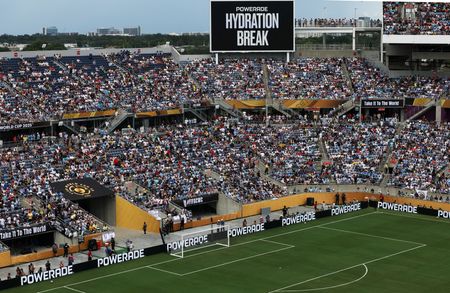

FIFA has implemented mandatory three-minute hydration breaks for each half of every World Cup match beginning this week across the United States, Mexico and Canada, marking the first time such breaks have been required tournament-wide.
The decision comes as organizers prepare for hot weather conditions and recall the extreme temperatures experienced during the 2025 Club World Cup. All 104 matches will feature these scheduled interruptions, creating unprecedented commercial opportunities for television networks.
As players hydrate and fans potentially step away for refreshments, broadcasting companies see a valuable chance to offer advertisers additional prime-time exposure and increase revenue streams.
The scheduled interruptions represent another way the World Cup is adopting characteristics similar to American sporting events, which feature extensive commercial breaks and entertainment elements. The tournament will also include a halftime performance by Colombian artist Shakira during the July 19 championship match, reminiscent of the Super Bowl’s entertainment format.
FIFA maintains that player safety drives their hydration break policy, though the approach may also encourage media rights growth as television networks compete for the additional revenue potential.
World Cup water breaks were initially introduced during a 2014 Brazil tournament match between the Netherlands and Mexico when temperatures surpassed 32 degrees Celsius. Since then, such breaks have been evaluated on an individual game basis.
Michael Johnson, who analyzes the U.S. sports market for S&P Global, explained to Reuters that incorporating hydration breaks could prove “extremely valuable and could potentially command those Super Bowl level prices within that seven to probably nine-million-dollar range.”
Marketing companies understand the massive exposure potential the World Cup offers, considering the 2022 Argentina versus France final in Qatar attracted 1.42 billion total viewers.
“U.S. viewers are used to the NFL style model, NBA style model four quarters. They’re used to in-game breaks. This World Cup is essentially a mirror to those style models,” Johnson explained.
European football traditionally follows a different broadcast model, with leagues such as the English Premier League typically shown on subscription services like Sky, where commercials appear before matches, during halftime, and after games conclude.
“I think even subscription broadcasters like Sky in the UK would be very happy to have a little bit more advertising inventory,” noted Francois Godard, who works as an independent sports industry analyst.
However, adopting this commercial-heavy approach may trigger negative reactions from international audiences who view it as excessive Americanization of the sport, particularly in European markets where most leagues compete during winter months.
“Soccer is infamous for continuous play. And purists are kind of worried about how this kind of Americanises the game… And create viewer fatigue, more ads could annoy fans, especially if they feel intrusive or excessive,” Johnson warned.
Additional interruptions could reduce fan engagement, especially among supporters already frustrated by frequent Video Assistant Referee delays lasting several minutes. Research by the Football Supporters’ Association within the Premier League revealed only 3.3% of fans felt VAR improved their match experience.
Many international broadcasters transmitting World Cup coverage have not yet announced whether they plan to utilize water breaks for advertising purposes.
British broadcaster ITV has already confirmed it will not air commercials during hydration breaks due to strict advertising regulations imposed by UK oversight body Ofcom.
“ITV is seeing regulatory issues and this is the first thing on their mind, but they also have to meet expectations from viewers. And I am not sure that British viewers would have been very welcoming to more advertising,” Godard observed.
The expanded 48-team format, increased from the previous 32-team structure, is projected to help FIFA achieve $8.9 billion in total 2026 revenue, with television broadcasting rights contributing 44% of that amount, according to FIFA’s budget projections.
FIFA has not indicated whether hydration breaks will become standard for future tournaments, though the 2030 and 2034 World Cups are scheduled for Spain, Portugal, Morocco, and Saudi Arabia respectively—all regions where summer temperatures regularly exceed 30 degrees Celsius during the traditional June-July tournament period.
The combination of expanding media rights cycles and hydration break opportunities may intensify competitive bidding between streaming services and traditional broadcasters for 2030 and 2034 tournament rights, although some regional rights for 2030 have already been secured.
“You’ll see most likely the streaming giants come into play, you know, Apple, Amazon, and especially Netflix, I think will be in the mix,” Johnson predicted, noting that Fox Sports’ current World Cup rights agreement expires following the 2026 tournament.
Netflix has already obtained U.S. broadcasting rights for the Women’s World Cup in 2027 and 2031, expanding a live sports catalog that features World Wrestling Entertainment and NFL games.