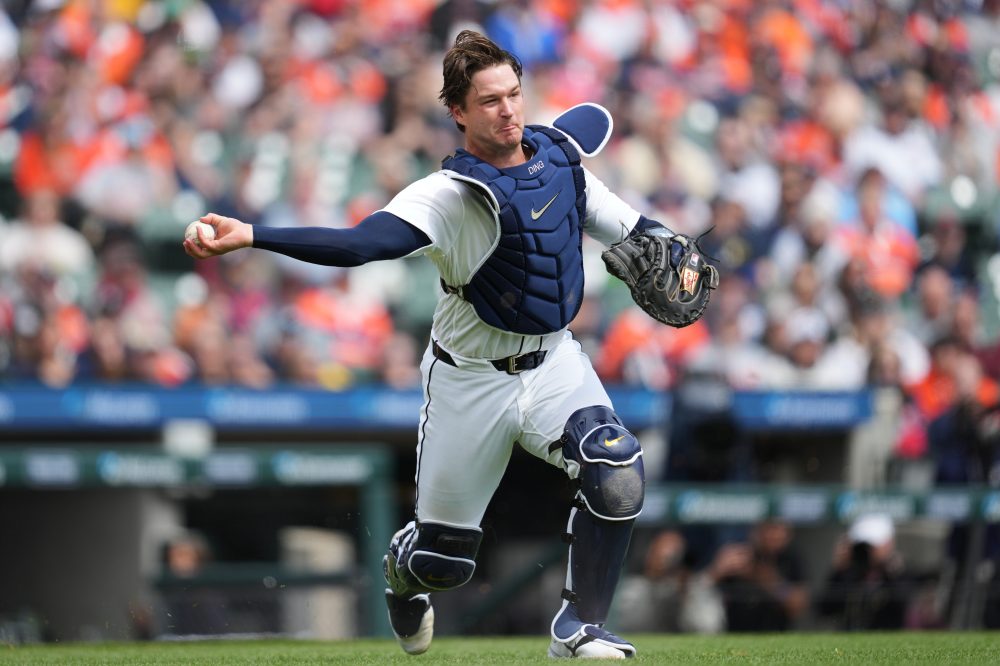

NEW YORK — During Major League Baseball’s inaugural week of robot umpire challenges, catchers significantly outperformed batters in successfully overturning calls, with the Detroit Tigers and David Dingler setting the pace.
Teams achieved an overall 55.2% success rate (299 of 542) with the Automated Ball-Strike System challenges, while defensive squads won 59.7% of their appeals (175 of 293), including a 60.4% success rate for catchers (169 of 280).
“I like it a little more. I was pretty staunch against it, which I still may be to some degree,” New York Yankees manager Aaron Boone said.
Pitchers made only 13 challenges, succeeding on six occasions. Hitters managed a 49.8% success rate (124 of 249).
“I think it’s fun. It’s its own game inside the game, almost,” Tampa Bay catcher Hunter Feduccia said.
The success rate improved from last year’s Triple-A performance of 49.5%, where defensive teams won 53.7% and batters succeeded 49.5% of the time.
Detroit topped all teams with a 75% success rate (15 of 20), followed by Arizona at 71%, while Baltimore and Cincinnati both achieved 67%.
Minnesota issued the most challenges with 32, winning 20 for a 63% rate. Texas made the fewest appeals, succeeding on 4 of 10 attempts.
Cleveland struggled most at 32% success, with Washington at 38% and both St. Louis and Texas at 40%.
Detroit’s catchers went perfect at 8-0, with Dingler accounting for seven victories.
The system’s influence became evident during Atlanta’s visit to Arizona last Thursday. With the Braves leading 2-1, Arizona’s Ryne Nelson delivered a 3-2 curveball to the upper, outside corner against Ozzie Albies that umpire Malachi Moore called a strike. Albies appealed and walked toward first base before the automated system revealed the pitch missed the strike zone by 1.1 inches. That walk sparked an eight-run rally in a 17-2 victory.
“In some of these games, it’s had a more of a swinging effect on outcomes of at-bats and how things change than maybe even you thought,” Miami manager Clayton McCullough said.
Los Angeles Angels catcher Logan O’Hoppe recorded the most individual wins, succeeding on 10 of 12 challenges. Miami’s Agustín Ramírez won 7 of 9 appeals and the Los Angeles Dodgers’ Will Smith succeeded 8 of 11 times.
Seattle’s Cal Raleigh won 4 of 9 challenges while Oakland’s Shea Langeliers succeeded 3 of 9 times.
Among hitters, New York Mets’ Mark Vientos and Iván Herrera both went 3-0. Los Angeles Angels’ Mike Trout finished 3-1 alongside Philadelphia’s Kyle Schwarber and Tampa Bay’s Jake Fraley.
Colorado’s Hunter Goodman and Washington’s Luis García Jr. both went 0 for 3.
Boone noted that Yankees personnel and players examine challenges made and missed opportunities on a daily basis.
Players continue adapting to the system. Washington’s Jorbit Vivas tapped his helmet requesting an appeal on March 31 after the Nationals had already used their two allowed challenges.
Regarding umpires, Mike Estabrook had 11 of 12 decisions overturned (91.7%), Andy Fletcher saw 15 of 17 reversed (88.2%), while Ron Kulpa and Paul Clemons each had 7 of 9 overturned (77.8%) and Chris Segal 10 of 13 (76.9%), according to taptochallenge.com.
Will Little had only 1 of 10 decisions reversed while Erich Bacchus maintained perfection with no overturned calls in five challenges. Additional umpires with low reversal rates among those with at least five challenges included Emil Jiménez (1 of 5), Jordan Baker (2 of 8), Ryan Additon and Nick Mahrley (both 2 of 7) and David Rackley (3 of 10).
Offensive production continued to struggle through the season’s first 139 games of 2,430 total.
The major league batting average of .234 dropped from .239 during last year’s opening week, when it concluded at .245. Averages typically rise as temperatures increase. The all-time low of .237 was established in 1968.
Mean fastball velocity reached 94.6 mph, rising from 94.1 mph during last year’s first week. The season-ending figure has climbed each of the past five years to a record 94.5 mph in 2025. It measured 91.9 mph when MLB began tracking in 2008.
“I wish I was facing the same pitching as I did my rookie year back when guys were throwing 88-mile-an-hour sinkers over the plate,” said 33-year-old Cleveland catcher Austin Hedges. “That pitch doesn’t exist anymore.”