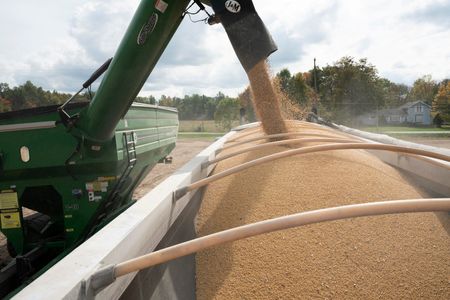

Delaware and Mid-Atlantic farmers are expected to join a nationwide shift toward planting more soybeans and reducing corn acreage in 2026, according to new projections released Thursday by federal agriculture officials.
The U.S. Department of Agriculture predicts farmers will plant approximately 94 million acres of corn this year, representing a decrease from the 89-year record high of 98.8 million acres planted in 2025. Meanwhile, soybean plantings are anticipated to increase to 85 million acres, up from 81.2 million acres the previous year.
Agricultural producers across the region are grappling with challenging economic conditions this planting season, including oversupplied global markets, depressed commodity prices, and escalating expenses for essential farming supplies like seeds and fertilizer. Federal data shows farm income is expected to decline by 0.7% even with near-record government support payments, which are projected to represent almost 29% of producers’ total revenue.
Throughout the Midwest and Mid-Atlantic regions, most agricultural operations cultivate both commodities, typically rotating between corn and soybeans on individual fields annually to maintain soil nutrients and health. However, some farmers may deviate from this standard rotation pattern when market conditions present opportunities for improved profitability.
The federal agency’s corn acreage projection, announced during its yearly Agricultural Outlook Forum, fell short of analyst expectations. A Reuters survey of industry experts had predicted an average of 94.9 million corn acres, while the soybean forecast exceeded the anticipated 84.9 million acres.
Depressed corn values and abundant stockpiles following a record-breaking U.S. harvest in 2025 are likely to discourage farmers from expanding corn plantings this season. However, strong demand from international buyers and ethanol biofuel producers should prevent more dramatic reductions, according to market analysts.
Soybean acreage is expected to grow despite continuing trade disputes with China, the largest importer, and intense competition from Brazil, where farmers are currently harvesting what appears to be a record crop. Increased domestic demand for soybean oil from renewable fuel manufacturers has helped maintain price stability.
Under typical weather conditions, federal forecasters project the 2026 U.S. corn harvest will reach 15.755 billion bushels, while soybean production is expected to total 4.450 billion bushels.
After meeting demand from exporters, livestock producers, and biofuel manufacturers, the United States is projected to have 1.837 billion bushels of corn remaining at the conclusion of the 2026/27 marketing year on August 31, 2027. This represents a decline from the seven-year peak of 2.127 billion bushels anticipated a year earlier.
Soybean inventory levels at the end of the 2026/27 season are forecast to increase modestly to 355 million bushels from 350 million bushels at the close of 2025/26.
Export projections show corn shipments declining to 3.1 billion bushels in 2026/27, down 200 million bushels from the previous year due to increased competition from South American suppliers. Conversely, soybean exports are expected to rise by 125 million bushels to reach a two-year high of 1.7 billion bushels.
Domestic soybean processing demand, which crushes beans into meal for animal feed and oil for food and biofuel applications, is projected to reach a record 2.655 billion bushels.
Wheat stockpiles are forecast at 933 million bushels by the end of the 2026/27 marketing year, remaining essentially flat from the previous year as reduced exports following large harvests in competing nations Argentina and Australia balance out decreased U.S. production.
Federal officials project wheat exports for 2026/27 at 850 million bushels, representing a 50 million bushel decrease from the current marketing year.