Author: ndrayton

  • FTC Acts to Stop Scheme that Bilked Millions out of Student Loan Borrowers

    FTC Acts to Stop Scheme that Bilked Millions out of Student Loan Borrowers

    The Federal Trade Commission has stopped a scheme that allegedly bilked millions of dollars out of consumers burdened with student loan debt by pretending to be affiliated with the U.S. Department of Education in violation of the FTC’s Impersonation Rule, collecting illegal advance fees, and making other deceptive claims.

    federal court temporarily halted the scheme and froze its assets at the request of the FTC, which seeks to end the defendants’ deceptive practices.

    “The defendants promised consumers student debt relief and forgiveness but gave them virtually nothing, keeping over $10 million for themselves and leaving consumers deeper in debt,” said Samuel Levine, Director of the FTC’s Bureau of Consumer Protection. “The FTC will continue taking decisive action against those who prey on Americans with student debt.”

    According to the FTC’s complaint, since at least January 2023, Nevada-based Superior Servicing and its operator Dennise Merdjanian made telemarketing calls and sent personalized mailers to borrowers falsely claiming that consumers enrolled in defendants’ program could obtain benefits such as loan consolidation, reduced interest rates on their student loans, reduced monthly student loan payments, or loan forgiveness. The operators collected illegal advance fees of up to $899 as an initial payment followed by monthly payments that defendants falsely represented were going towards consumers’ student loan debt.

    To convince borrowers that their claims were legitimate, the operators allegedly pretended to “work with” or be affiliated with the Department of Education or its approved loan servicers and, in some instances, even advised consumers to stop making payments to their existing loan servicers. The operators then falsely claimed that they would take over responsibility for servicing consumers’ loans, collect monthly student loan payments for a term of up to 20 years, and said that upon completion of those monthly payments, the consumers’ federal student loan debt would be forgiven.

    Contrary to Superior Servicing’s false promises, borrowers have reported that they never received loan consolidation, lowered payments, or loan forgiveness, according to the complaint. The FTC noted that at most, and if anything at all, the defendants filled out simple applications for debt relief that are available for free from the Department of Education.

    The FTC charged that the scheme’s operators violated the Impersonation Rule by claiming to be affiliated with the Department of Education, as well as the FTC Act’s prohibition on deceptive practices, the Telemarketing Sales Rule, and the Gramm-Leach-Bliley Act.

    The Commission vote authorizing the staff to file the complaint was 5-0. The U.S. District Court for the District of Nevada entered a temporary restraining order on November 22, 2024 and a preliminary injunction against corporate defendant Superior Servicing on December 6, 2024.  

    The lead staff attorneys on this matter were John O’Gorman, Luis Gallegos, and Reid Tepfer of the FTC’s Bureau of Consumer Protection.

    NOTE: The Commission files a complaint when it has “reason to believe” that the named defendants are violating or are about to violate the law and it appears to the Commission that a proceeding is in the public interest. The case will be decided by the court.

  • FTC Staff Issues Report on Undercover Funeral Rule Phone Sweep

    FTC Staff Issues Report on Undercover Funeral Rule Phone Sweep

    The staff of the Federal Trade Commission have issued a report detailing key findings from the agency’s first-ever undercover Funeral Rule phone sweep, which found several funeral providers failed to provide pricing information required by law.

    The FTC’s Funeral Rule requires providers to give information about their offerings and pricing over the phone, when asked.

    As detailed in the report, FTC staff reviewed calls placed to 278 randomly selected funeral providers to contact from the largest, middle, and smallest metropolitan and micropolitan areas in the country from February 2023 through December 2023. For each of the randomly selected funeral providers, staff made up to three attempts to reach the provider by phone during business hours (9am-5pm), and up to three attempts outside of business hours. On the calls, staff asked for pricing information, typically for direct cremation, cremation and a memorial service, and cremation and a viewing.

    The report notes that staff was unable to obtain price information after business hours from 73 funeral providers (26% of all funeral providers called). Staff also was unable to obtain price information from 21 providers (7% of all funeral providers called) during business hours, according to the report.

    The report also shows that in many instances, multiple calls were needed to obtain price information from a funeral provider. After business hours, staff either had to call more than once or wait for a return call from nearly 70% of the funeral providers called during the sweep. During business hours, staff had to call multiple times or wait for a return call for about 30% of the funeral providers called.

    Finally, the report details that half of the funeral providers called answered at least some questions about pricing with estimates or ranges, rather than actual prices. The report also notes that at least 33% of the funeral homes provided package pricing for at least one service on a call (such as cremation with a viewing), without giving itemized price information for that service. In addition, staff found that at least 37 funeral providers quoted different prices for the same services on different calls. 

  • Federal Court Orders Harris Jewelry to Restore its Website and Claims Portal for Servicemembers to Request Refunds

    Federal Court Orders Harris Jewelry to Restore its Website and Claims Portal for Servicemembers to Request Refunds

    A federal court has ordered Harris Jewelry to reopen its claims process and renotify consumers, most of whom are active duty servicemembers, to submit their claims for refunds. The court found Harris Jewelry violated its prior settlement with the Federal Trade Commission and a multistate group led by the New York Attorney General’s Office by prematurely shutting down the claims portal.

    The new claims process is open for 33 days, starting today, November 18, 2024 and ending Saturday, December 21, 2024.

    The agency is encouraging consumers who purchased items from Harris Jewelry and paid for a Lifetime Jewelry and Watch Protection Plan, and have yet to file a claim or previously filed a claim but not yet heard back from Harris Jewelry, to request a refund via Harris’s website as soon as possible.

    In July 2022, the FTC and a group of 18 states took action and stopped the national jewelry retailer from cheating military families with illegal financing and sales practices. According to the complaint, the jewelry company deceptively claimed that financing jewelry purchases through Harris would raise servicemembers’ credit scores, misrepresented that its protection plans were not optional or were required, and added the plans to purchases without consumers’ consent. The company also allegedly violated numerous financial consumer protection laws, including the Military Lending Act.

    Under a stipulated order with the FTC and the multistate group, Harris was ordered to stop collecting millions of dollars in debt, provide refunds for purchased protection plans, which could total approximately $10.9 million, issue refunds for overpayments, and assist with the deletion of any negative credit entries pertaining to debt in consumers’ credit reporting files. Harris is also required to complete its shutdown of operations and to dissolve pursuant to applicable state laws, once it meets the obligations of the stipulated order.

    The court’s recent action, in response to a request from the FTC and the multistate group, is aimed at allowing consumers fair and sufficient time to file claims for refunds, in response to the 2022 settlement.

  • FTC Takes Action Against Qargo Coffee for Franchise Rule Violations

    The Federal Trade Commission has taken action against coffee shop franchise Qargo Coffee and its founders for failing to disclose critical information required by the Franchise Rule, including one founder’s ties to burger franchise BurgerIM, leaving prospective franchisees in the dark when deciding whether to invest in the franchise.

    In its complaint, the FTC alleged that Qargo and founders Mark Bastorous, Bernadette Bastorous, and Samir Shenouda violated the FTC’s Franchise Rule—the agency’s second case in recent years alleging violations of the Franchise Rule.

    “Before franchisees take on the risk and investment of starting a business, they deserve to know basic information about the opportunity upfront—from the franchise’s overall financial health to the time it would take to set up shop,” said FTC Chair Lina M. Khan. “The FTC will continue using all its tools to ensure that franchisees, small businesses, and entrepreneurs can get a fair shot.”

    The complaint notes that Qargo’s founders, which have offered a coffee shop franchise throughout the country since May 2020, violated the Franchise Rule by failing to provide prospective franchisees with critical information needed to weigh the risks and benefits of purchasing a huge investment like a franchise in Qargo’s franchise disclosure document (FDD). The FTC also alleged that Qargo called its franchisees in California “licensees” and completely failed to provide prospects in California with any FDD.

    In addition, the Commission alleged that Qargo and its founders violated the FTC Act by engaging in unfair practices and making misrepresentations to prospective franchisees. For example, defendants omitted information about the business history and experience of its executives and made misrepresentations about how long it takes for franchises to get off the ground and whether there were any bankruptcies that needed to be disclosed.

    The proposed order against Qargo and its founders imposes a $1,258,575 judgment. Based on the proposed defendants’ inability to pay the full amount, the proposed order requires the defendants to pay $30,000, with the remaining judgment suspended. The proposed order also:

    • Requires Qargo and its founders to provide written notice to its franchisees and licensees, informing them of their right to rescind their contracts without penalty;
    • Prohibits the defendants from enforcing or threatening to enforce any noncompete agreement or provision against any franchisee or licensee who rescinds their contract;
    • Prohibits the defendants from making misrepresentations or deceptive omissions of any fact material to prospective franchisees; and
    • Requires the defendants to comply with the Franchise Rule, including by providing franchise disclosure documents to prospective franchisees.

    The Commission vote authorizing the staff to file the complaint and stipulated final order was 5-0. FTC filed the complaint and final order in the U.S. District Court for the Southern District of Florida.

    NOTE: The Commission files a complaint when it has “reason to believe” that the named defendants are violating or are about to violate the law and it appears to the Commission that a proceeding is in the public interest. Stipulated final orders have the force of law when approved and signed by the District Court judge.

    FTC’s lead attorneys on this matter are Christine M. Todaro and Josh Doan in the FTC’s Bureau of Consumer Protection.

  • FTC Extends Comment Period on RFI Related to Franchise Agreements and Business Practices to Oct. 24

    The Federal Trade Commission has extended by two weeks the deadline for members of the public to comment in response to the agency’s Request for Information (RFI) on franchise agreements and franchisor business practices, including how franchisors may exert control over franchisees and their workers.

    Due to the impact of Hurricane Milton and Hurricane Helene, the FTC is extending the original October 10, 2024 deadline for public comment until October 24, 2024. Information on how to submit comments can be found online at regulations.gov.

    In July 2024, the FTC released a policy statement and guidance warning that franchisor contract provisions that cut off communications with the government and undisclosed junk fees are unlawful. To ensure continued engagement with all market participants, the FTC announced it was reopening its 2023 RFI on franchise agreements and business practices. In particular, the agency expressed interest in learning how franchisors disclose certain aspects and contractual terms of the franchise relationship, as well as the scope, application, and effect of those aspects and contractual terms.

  • FTC Presents Criminal Liaison Unit Award to USPIS Postal Inspector Kathy Broderick

    The Federal Trade Commission has awarded Kathy Broderick, a retired Postal Inspector in the U.S. Postal Inspection Services’ Chicago Division, with the Commission’s 2024 Criminal Liaison Unit Consumer Shield Award. The award recognizes a criminal investigator exemplifying the spirit of cooperation that the Criminal Liaison Unit (CLU) seeks to promote.

    “American consumers have benefitted immeasurably from the excellent law enforcement partnership between the FTC and the U.S. Postal Inspection Service,” said James Kohm, Associate Director of the FTC’s Division of Enforcement. “Kathy’s invaluable service is a great example of that partnership and illustrates why it is so important.”

    Broderick has provided critical assistance over many years to FTC attorneys and investigators on a range of cases combatting fraud, including enforcement actions against those deceptively marketing health care products, “discount” cards, and business directory services—schemes that have cost consumers more than $200 million. Her work helping the FTC identify the people behind these schemes, locating where the entities operated, and developing evidence to prove the alleged fraudulent practices has benefitted American consumers. In addition to helping the FTC in its civil law enforcement work, some of the cases that Broderick has assisted with also have led to multiple criminal prosecutions resulting in convictions and prison sentences.

    The FTC often coordinates with criminal law enforcement to ensure the successful prosecution of fraudsters who prey on American consumers. Since its inception in 2003, the FTC’s CLU has contributed to the successful criminal prosecution of thousands of fraudulent telemarketers, mortgage relief scammers, health care fraudsters, and others preying on American consumers.

  • Career Step to Pay $43.5 Million in Cash and Debt Cancellation to Resolve Charges It Used Deceptive Advertising to Lure Servicemembers and Their Spouses

    Career Step to Pay $43.5 Million in Cash and Debt Cancellation to Resolve Charges It Used Deceptive Advertising to Lure Servicemembers and Their Spouses

    Online career-training company, Career Step, LLC has been ordered to pay $43.5 million in debt cancellation and cash to resolve charges brought by the Federal Trade Commission that alleged the company lured consumers, specifically servicemembers and their families, with deceptive ads that falsely touted inflated employment outcomes, job placement, and partnerships with prominent companies.

    Career Step will pay $27.8 million in debt cancellation and $15.7 million in cash that will be used to provide redress to consumers who were harmed by its deceptive advertising.

    “Servicemembers and their families make sacrifices every day to protect our freedoms,” said Samuel Levine, Director of the FTC’s Bureau of Consumer Protection. “We owe it to them to make sure that when they look to use their hard-earned benefits to further their education, they get facts and not fantasy.”

    According to the FTC’s complaint, Georgia-based company Career Step (also doing business as CareerStep, CareerCert, and Carrus), promotes career training and certification programs for jobs in the healthcare industry, targeting servicemembers and their spouses. The complaint states that since at least 2019, Career Step has lured servicemembers with deceptive advertising on social media and on its website, where it markets its programs, using sales representatives and AI technology to persuade consumers to enroll. The company has also marketed its services through military-focused publications, such as Military.com, and through events sponsored by the military, including job fairs. Specifically, Career Step has made false claims about job placement and outcomes, externships, hiring partnerships, and the duration of its programs, with the help of deceptive incentivized reviews it uses to promote its services.

    The FTC’s complaint says that Career Step representatives have falsely promised to find jobs for consumers. For example, Career Step representatives have claimed that the “career placement team” will step in and find consumers the “perfect job.” In reality, Career Step does not provide any job placement. Career Step’s job search assistance is limited to help with resume-drafting or emailing links to job postings generally available on the internet.

    The complaint says the company has also represented that “most learners” and “more than 80% of its graduates,” or program-completers, are employed in their field of study. Career Step’s employment outcome claims are based entirely on an optional survey sent only to consumers who have completed their program. But most participants never complete their program at all and never even receive a survey. Of the consumers that do receive a survey, most never respond. For instance, out of the 9,330 enrollees and 2,126 program-completers from a 2020 survey, only 5% of enrollees or 24% of program-completers completed the survey, representing a small pool of consumers.

    Career Step’s website has claimed falsely that it has partnerships with leading businesses in the healthcare industry to provide jobs for its graduates, according to the complaint. Career Step prominently featured the logos of well-known “Hiring Partners” like CVS and Walgreens on its homepage, and the company’s sales representatives have told consumers, “We have over 50,000 partnerships so we’ll help you find some place to work.” In reality, Career Step’s agreements, including with companies like CVS and Walgreens, have nothing to do with job placement after graduation.

    Career Step “Our Trusted Employer Network” homepage example

    The FTC also charged that Career Step has falsely told students that it would place them in an externship as part of its program. But the complaint notes that less than 10 percent of students in externship-required programs were ever placed in an externship. Without an externship, those consumers have been unable to complete their programs, wasting all the time and money they had already invested with Career Step.

    The company has also falsely promised that students would complete their program in four months or less even though the vast majority of Career Step students never complete their programs. Even of those who do complete them, most take much longer than four months because of roadblocks from the company. For example, consumers report frequent issues with the website and difficulty getting any response from Career Step representatives. And because the company frequently fails to place consumers in the externships required to complete their programs, many Career Step students have seen their programs expire before they could complete them or have been forced to pay for extensions on their programs, which can cost as much as $999.

    Finally, Career Step conducted a deceptive incentivized review program to get consumers to post reviews on the BBB website, Google, and Trustpilot, the complaint notes. The company offered students a free extension—up to three months of “complimentary” extra time on their programs—for leaving a review on each of the three specified sites. Students were asked to screenshot their review or copy the link and send it back to Career Step as proof. In many cases, these reviews falsely appear to reflect the opinions and experiences of ordinary, uncompensated Career Step students.

    The settlement, which must be approved by a federal judge before it can go into effect, requires Career Step to pay $15.7 million, which the FTC will use for consumer redress. The company must also cancel approximately $27.8 million in debts owed to Career Step by current or former students who enrolled between February 2020 and February 2023. The stipulated order also prohibits Career Step from deceptively advertising any educational product or service.

    Specifically, Career Step cannot misrepresent:

    • employment, hiring, or career prospects;
    • the number or percentage of consumers who obtain employment;
    • whether any individual was employed, hired, or obtained a job as a result of Career Step’s educational products or services;
    • partnerships with any companies or employers;
    • career services;
    • its externship program;
    • the typical or expected duration of a program;
    • the total costs or terms of the educational program or service;
    • the objectivity or impartiality of any content; or
    • any fact material to consumers concerning any good or service.

    Finally, Career Step must notify each third-party platform or website displaying a review written by a consumer to whom Career Step provided free services in exchange for the review about the FTC’s action against the company. The notice also must list all such reviews with enough information to allow the website or platform to easily identify them, and Career Step must inform the website or platform about the FTC order and request that the website or platform remove those reviews as soon as possible.

    The Commission vote authorizing the staff to file the complaint and stipulated final order was 5-0. The complaint and stipulated final order will be filed in the U.S. District Court for the Northern District of Georgia. Commissioners Melissa Holyoak and Andrew N. Ferguson issued concurring statements.

    The staff attorneys on this matter are Stephanie Liebner, Samuel Jacobson, Sally Tieu, and Michelle White, of the FTC’s Bureau of Consumer Protection.

    NOTE: The Commission files a complaint when it has “reason to believe” that the named defendants are violating or are about to violate the law and it appears to the Commission that a proceeding is in the public interest. Stipulated final orders have the force of law when approved and signed by the District Court judge.

  • FTC Acts to Stop Debt Relief Scheme Targeting  Spanish-Speaking Student Loan Borrowers

    FTC Acts to Stop Debt Relief Scheme Targeting Spanish-Speaking Student Loan Borrowers

    The Federal Trade Commission has stopped the operators of a scheme that it says tricked financially strapped consumers seeking student loan relief into paying hundreds of dollars in junk fees. The operators often targeted Spanish-speaking consumers in Puerto Rico, pretended to be affiliated with the Department of Education and its loan servicers, and made false promises of low, permanently fixed monthly payments and loan forgiveness.

    federal court temporarily halted the scheme and froze its assets at the request of the FTC, which seeks to end the unlawful practices and secure redress for the thousands of consumers who have been harmed.

    “By pretending to be affiliated with the Department of Education and misrepresenting features of its free income-driven loan repayment programs, these scammers bilked millions from the consumers these programs were designed to help,” said Samuel Levine, Director of the FTC’s Bureau of Consumer Protection. “We are pleased that the court preliminarily shut down this predatory operation and froze its assets, and we will continue our efforts to crack down on junk fees, unwanted calls, and exploitation of consumers struggling with student loan debt.”

    According to the FTC’s complaint, since at least April 2019, Florida-based Start Connecting LLC and Colombia-based Start Connecting SAS (collectively doing business as USA Student Debt Relief (USASDR) and their owners and operators Douglas Goodman, Doris Gallon-Goodman, and Juan Rojas have enticed consumers by falsely suggesting an affiliation with the government or its student loan servicers. USASDR also falsely promised to enroll consumers in programs that guarantee permanent low, fixed monthly payments—as low as $9 per month—followed by generous lump-sum loan forgiveness of the remaining balance. In exchange for enrollment, the operators have charged consumers illegal advance fees of several hundred dollars followed by monthly fees of as much as $29. Although USASDR claimed it would apply consumers’ monthly payments to their loan balances, in reality USASDR’s operators pocketed consumers’ hard-earned money and offshored much of the funds to Colombia.

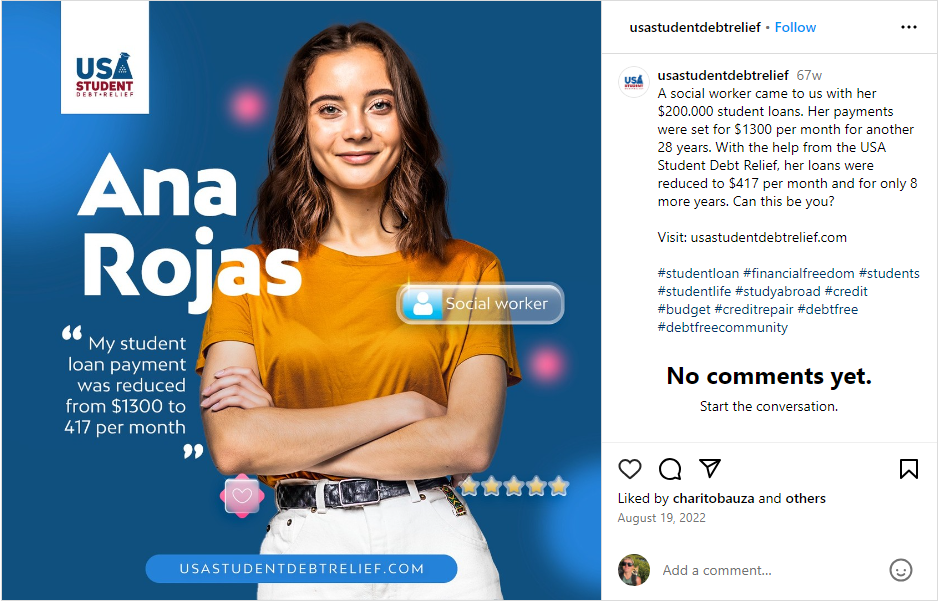
    The complaint also notes that USASDR falsely marketed its services with fake testimonials and reviews on its website and social media pages, as well as on third-party consumer review platforms like those hosted by the Better Business Bureau and Trustpilot. For example, USASDR posted testimonials to its Instagram and Facebook pages that falsely appeared to recount real consumers’ positive experiences with the company. One such testimonial posted on August 19, 2022 purported to recount the experience of “Ana Rojas” and falsely claimed that USASDR had reduced her loan payments from $1,300 per month for 28 years to only $417 per month for eight 8 years.

    Image
    Fake Consumer Testimonial posted August 19, 2022

    Fake Consumer Testimonial posted August 19, 2022

    In reality, according to the complaint, this review and others like it are fabricated. Fake testimonials like the one from Ana Rojas feature stock photos available for download online and describe permanently-fixed-monthly-payment scenarios that cannot be obtained under any income-driven repayment plan.

    In addition, the complaint alleges that USASDR telemarketers based in Colombia placed unwanted telemarketing calls to consumers throughout the United States, including consumers on the Do Not Call Registry, and disproportionately targeted consumers in Puerto Rico. Of the more than 750,000 outbound calls that USASDR telemarketers made to consumers between April 2019 and February 2024, approximately 220,000—nearly 30 percent—went to consumers with a Puerto Rico area code, many of whom only spoke Spanish. The complaint further notes that USASDR unfairly provides Spanish-speaking consumers with fine-print contracts written in English, even though the sales pitch and email communications to those consumers are generally in Spanish and targeted consumers who do not speak or read English fluently, if at all.

    The FTC thanks the U.S. Department of Education, the Better Business Bureau of West Florida, the California Department of Financial Protection and Innovation, and the Minnesota Attorney General’s Office for their assistance with this matter. 

    The Commission vote authorizing the staff to file the complaint was 5-0. The complaint was filed in the U.S. District Court for the Middle District of Florida. The court entered a temporary restraining order on July 11, 2024.

    NOTE: The Commission files a complaint when it has “reason to believe” that the named defendants are violating or are about to violate the law and it appears to the Commission that a proceeding is in the public interest. Stipulated final orders have the force of law when approved and signed by the District Court judge.

    The lead staff attorney on this matter was Nathan Nash, D’Laney Gielow, and Karen Dodge of the FTC’s Bureau of Consumer Protection.

  • FTC Takes Action to Ensure Franchisees’ Complaints are Heard and Protect Against Illegal Fees

    Today, the Federal Trade Commission and its staff took a suite of actions to address growing concern about unfair and deceptive practices by franchisors—to ensure that the franchise business model remains a ladder of opportunity to owning a business for honest small business owners.

    Among the actions being announced today by the FTC include a policy statement that warns that franchisors’ use of contract provisions, including non-disparagement clauses that prohibit franchisees’ communications with the government, violate the law. The statement emphasizes that franchisee reports and voluntary interviews are a critical part of FTC investigations and franchisees’ reluctance or inability to file reports and discuss their experiences may hamper the agency’s work to protect franchisees. Threats of retaliation against a franchisee for reporting potential law violations to the government are unlawful.

    FTC staff also released new guidance from franchisees that were not previously disclosed. In response to the FTC’s request for information, franchisees reported ever increasing payment processing and technology fees that make it difficult to make a living, while others identified undisclosed fees for training, marketing, property improvement, or any other product or service required by the franchisor. Today’s staff guidance makes clear that it is illegal for franchisors to impose undisclosed junk fees—fees that raise costs and which may make the difference between a profitable franchise and an unsustainable one.

    “Franchising is a chance for Americans to build a business, but the FTC has heard concerns about how unfair franchisor practices, like a failure to fully disclose fees upfront, go unreported thanks to a fear of retaliation,” said FTC Chair Lina M. Khan. “Today the Commission is making clear that contractual terms prohibiting franchisees from reporting potential law violations to the government are unfair, unenforceable, and illegal.”

    Today FTC staff also released an Issue Spotlight summarizing the top concerns raised by franchisees in response to a 2023 Request for Information. The FTC received more than 2,000 comments in response to the RFI, including from franchisees, franchisors and other stakeholders. The Issue Spotlight also describes staff analysis of Small Business Administration loan default data, finding that certain franchisors appear to present riskier investments than others.

    Finally, to facilitate continued engagement with all market participants on these topics, FTC staff is reopening the comment period for the 2023 Request for Information (RFI) related to franchise agreements and franchisor business practices. Interested franchise stakeholders can submit comments to the Commission until October 10, 2024 online at the regulations.gov comment submission portal.

    All of these franchise resources can be found at the newly launched FTC franchise website [link]. Prospective and current franchisees and franchisors can use the website as a single resource for the FTC’s latest franchising materials.

    The Commission voted 3-2 to adopt the policy statement. Commissioners Melissa Holyoak and Andrew N. Ferguson voted no and each issued dissenting statements.

  • FTC Publishes Inflation-Adjusted Monetary Thresholds for Three Exemptions in Franchise Rule

    The Federal Trade Commission has adjusted for inflation three monetary exemption thresholds used to determine whether the sale of a franchise qualifies for an exemption under the agency’s Franchise Rule. The rule requires franchisors to disclose key information prospective buyers need to evaluate the risks and benefits of investing in a franchise.

    The rule requires the FTC to adjust the thresholds for inflation every four years based on the Consumer Price Index. The exemptions from compliance with the rule, which will take effect July 12, 2024, are:

    • Sales where the buyer pays less than $735 (currently $615) for the franchise;
    • Sales requiring a large investment where the franchisee pays at least $1,469,600 (currently $1,233,000), excluding the cost of unimproved land and any franchisor (or affiliate) financing; and
    • Sales to large entities, such as multi-unit franchisees, airports, hospitals, and universities that have been in business for at least five years and have a net worth of at least $7,348,000 (currently $6,165,000).

    The Commission vote to approve the Federal Register notice was 5-0. The notice was published in the Federal Register.

  • FTC Acts to Stop Student Loan Debt Relief Scheme that Took Millions from Consumers in First Case under the Impersonation Rule

    In its first case under the Impersonation Rule, the Federal Trade Commission has stopped a student loan debt relief scheme that bilked more than $20.3 million from consumers seeking debt relief by pretending to be affiliated with the Department of Education.

    federal court temporarily halted the scheme and froze its assets– at the request of the FTC, which seeks to end the defendants’ deceptive practices. The FTC charged that the company also falsely claimed that they would take over consumers’ student loans to get them loan forgiveness that did not exist.

    “These defendants promised to lower student loan payments, but then took millions of dollars from consumers and did nothing, leaving them in deeper debt,” said Samuel Levine, Director of FTC’s Bureau of Consumer Protection. “The FTC will continue taking decisive action against those who exploit Americans struggling with student debt.”

    According to the FTC’s complaint, since at least June 2021, California-based Panda Benefit Services (also doing business as Prosperity Benefit Services), Clarity Support Services, Pacific Quest Services, Prosperity Loan Services, Public Processing Services, Quick Start Services, Select Student Services, Signature Processing Services, and its operators Christopher Hanson, Eduardo Martinez, Emiliano Salinas, and Melissa Salinas, preyed on consumers burdened with student loan debt and tricked them into paying hundreds to thousands of dollars in illegal junk fees towards loan forgiveness that did not exist.

    The FTC says that Prosperity Benefit Services, its affiliated companies, and operators falsely claimed that consumers who paid for their program were guaranteed to receive loan forgiveness and that the program would significantly reduce their loan payments. The operators also falsely claimed to take over the servicing of consumers’ student loans and told consumers that they were affiliated with the Department of Education.

    The complaint notes that in many instances, the operators would send mailers with urgent language like “FINAL NOTICE” and “Time Sensitive,” and boasted benefits like “complete loan forgiveness” and “tax free loan forgiveness” to entice consumers to call them and speak to a telemarketer. When consumers called the number on the mailers, they would speak with telemarketers who then convinced them that if they signed up for the debt relief program, they would be eligible for loan forgiveness after only a few months or years, a substantially shorter time than what is available under federal government repayment programs. Many consumers have reported that after signing up and making payments, they never received loan forgiveness and that the scheme’s operators never applied for loan forgiveness on their behalf.

    In addition, the operators of the scheme falsely claimed that they would take over consumers’ loans and claimed that they buy their loans from consumers’ federal servicers. By falsely claiming they worked with or were affiliated with the Department of Education, the scheme’s operators were able to obtain consumers’ bank account or debit card information, and typically collect hundreds of dollars in illegal upfront fees from consumers, according to the FTC.

    Contrary to their promises, in many instances the operators did not obtain loan forgiveness or lower payments for consumers, and because borrowers of federal student loans were not required to make payments on their loans between March 2020 and October 2023 due to the federal COVID-19 payment pause, many consumers have often gone months or years before finding out that their student loan payments were not lowered and that their loans had not been forgiven.

    The Impersonation Rule, which went into effect April 1, gives the agency stronger tools to combat and deter scammers who impersonate government agencies, such as the Department of Education, and businesses, enabling the FTC to file federal court cases seeking to get money back to injured consumers and civil penalties against rule violators. In addition to the Impersonation Rule, the agency says the defendants also violated the FTC Act, the Telemarketing Sales Rule, and the Gramm-Leach-Bliley Act.

    The Commission vote authorizing the staff to file the complaint was 5-0. The U.S. District Court for the Central District of California entered a temporary restraining order on June 24, 2024.  

    NOTE: The Commission files a complaint when it has “reason to believe” that the named defendants are violating or are about to violate the law and it appears to the Commission that a proceeding is in the public interest. The case will be decided by the court.

  • FTC Action Leads to Industry Ban for Ringleader of Student Loan Debt Relief Scam

    The ringleader of a student loan debt relief scam will be permanently banned from the debt relief industry and is required to turn over assets as part of a settlement with the Federal Trade Commission.

    The settlement with Marco Manzi resolves FTC charges involving the student loan debt relief scheme. The FTC charged that Manzi, Ivan Esquivel, and Robert Kissinger, operators of Express Enrollment LLC (also doing business as SLFD Processing) and Intercontinental Solutions LLC (also doing business as Apex Doc Processing LLC), pretended to be affiliated with the U.S. Department of Education and used “Biden Loan Forgiveness” or similar names to trick students into signing up for their student debt relief scheme. The FTC said that Apex operators pocketed approximately $8.8 million in junk fees by luring students with false promises of loan forgiveness.

    The FTC announced a settlement in February 2024 with the other defendants in the case, Esquivel, Kissinger and the corporate defendants, which imposed similar requirements as the proposed order against Manzi.

    The FTC has resources on how to avoid student loan debt relief scams at ftc.gov/StudentLoans. Consumers can get assistance with their student loans for free at StudentAid.gov.

    The Commission vote authorizing the staff to file the stipulated final order was 3-0. The FTC filed the final order in the U.S. District Court for the Central District of California. The Court approved the final order on March 15, 2024.

    The staff attorneys for this matter are Carlton Mosley and Gregory Ashe of the FTC’s Bureau of Consumer Protection.

  • 24 International Competition Network Participants Issue Joint Statement on Increasing Tech Capacity to Keep Pace with Increasing Digitization of the Economy

    The Federal Trade Commission and other member agencies of the International Competition Network (ICN) jointly issued a statement about how regulatory agencies can increase their tech capacity to keep pace with the increasing use of technology across industries.

    The joint statement grew out of a first-ever Technology Forum convened March 25-26 in Washington DC by competition and consumer protection authorities who participate in the ICN and hosted by the FTC.

    Separately, a number of U.S. federal and state agencies, including the FTC, also released agency-specific action statements today on tech capacity. These statements reflect concrete actions to increase tech capacity, including actively hiring technologists, which will help the agencies enforce existing laws and design remedies that work for consumers, workers, small businesses, and others.

    The FTC also released a new staff report today that details the evolution of the agency’s work to expand its technological expertise and how the agency’s Office of Technology, created in early 2023, applies its subject matter expertise to assisting the agency’s enforcement and regulatory work.

    A Joint Statement on Increasing Tech Capacity in Law Enforcement Agencies Around the World

    The joint statement recognizes that the increasing digitization of economies around the world require a greater level of expertise in order to assess the behavior of companies and the ability to weigh potential benefits and risks of technology. The statement notes that integrating technological expertise in competition and consumer protection enforcement work can help ensure timely intervention to tackle problems at their inception. This includes detecting consumer harms or anticompetitive conduct, targeting unlawful practices before they are widely adopted, or assessing market conditions that could lead markets to tip. This can help limit harms, promote greater competition and innovation, and save time and resources over the long term.

    The joint statement also calls for building interdisciplinary technological expertise by hiring roles across software and hardware engineering, product design and user experience, data science, investigative and user research, expertise in machine learning and artificial intelligence, ad tech and others. Lastly, the participants called for building on this year’s ICN Technology Forum through continued engagement and cross fertilization of ideas and best practices.

    The lead staffers on these matters include Noam Kantor, Amritha Jayanti, and Stephanie Nguyen in the Office of Technology and Paul O’Brien and Maria Coppola in the Office of International Affairs.

  • Federal Trade Commission Warns of Scammers Pretending to be Agency Staff

    The Federal Trade Commission is warning the public that scammers are pretending to be affiliated with the FTC to steal consumers’ hard-earned money.

    The FTC will never tell consumers to move their money to “protect” it. The FTC will never send consumers to a Bitcoin ATM, tell them to go buy gold bars, or demand they withdraw cash and take it to someone in person. It will also never contact consumers to demand money, threaten to arrest or deport them, or promise a prize. If someone claims to work for the FTC and makes any of these demands or threats, they are a scammer. 

    Staff has received many calls directly from consumers reporting that scammers used the names of real FTC employees to convince them to move, transfer, send or wire money. The median loss to FTC impersonators has increased from $3,000 in 2019 to $7,000 in 2024. The agency has issued guidance on how to spot and avoid these FTC impersonation scams and asks people to report them at ReportFraud.ftc.gov in English or ReporteFraude.ftc.gov in Spanish.

    Government and business impersonation scams have cost consumers billions of dollars in recent years, and both categories saw significant increases in reports to the FTC in 2023. In light of surging complaints around impersonation fraud, the FTC recently announced that it has finalized the Government and Business Impersonation Rule, which gives the agency stronger tools to fight scammers and return money to consumers harmed by impersonators.

  • FTC Sends More Than $4.1 Million in Refunds to People Who Lost Money to Student Loan Debt Relief Scheme

    The Federal Trade Commission is sending more than $4.1 million in refunds to people who lost money to student loan debt relief scammers who lured consumers with fake loan forgiveness claims and pocketed their money. The scheme used many names including Mission Hills Federal, Federal Direct Group, National Secure Processing, and The Student Loan Group.

    The FTC filed a complaint against the operators of Mission Hills Federal and Federal Direct Group in 2019, alleging that since 2014 they tricked students into paying hundreds to thousands of dollars in illegal upfront fees and pretended to lower consumers’ monthly student loan payments. The operators also tricked consumers into sending their monthly student loan payments directly to the defendants by falsely claiming to take over the servicing of the consumers’ loans. In reality, few payments were actually applied to consumers’ student loans and in many cases, none at all. Instead, the defendants kept consumers’ money for themselves.

    The FTC is sending checks to 27,584 consumers. Recipients should cash their checks within 90 days, as indicated on the check. Consumers who have questions about their payment should contact the refund administrator, JND Legal Administration, at 1-844-566-0108, or visit the FTC website to view frequently asked questions about the refund process. The Commission never requires people to pay money or provide account information to get a refund.

    The Commission’s interactive dashboards for refund data provide a state-by-state breakdown of refunds in FTC cases. In 2023, FTC actions led to more than $324 million in refunds to consumers across the country million in refunds to consumers across the country. 

  • FTC and Partners Kick Off National Consumer Protection Week 2024

    As part of National Consumer Protection Week (NPCW), the Federal Trade Commission and its partners, including consumer organizations, national advocacy organizations, and other federal, state, and local government agencies will participate in several virtual and in-person events on issues such as avoiding scams, protecting people against identity theft, and reporting fraud for people in all communities.

    During the week of March 2-8, 2024, the FTC and NCPW partners will host and participate in social media events, podcasts, webinars, and other events to help people understand their consumer rights and avoid fraud, scams, and identity theft.

    All these events are open to the public and virtual, except where noted.

    All Week

    • Follow the FTC on Twitter/X at @FTC and on Facebook for resources and advice on avoiding frauds and scams.
    • Listen in to The Fraudian Slip podcast. FTC staff will share information on avoiding and recovering from identity theft and new language access resources.
    • Watch the City of Palmdale’s video series featuring FTC staff on how to spot and avoid scams.

    Saturday, March 2 & Sunday, March 3

    Monday, March 4

    • 2pm ET: Join the FTC for a webinar on identity theft and college students. Staff will share information on how college students can avoid and recover from identity theft and free publications that can be distributed on campus.
    • In-person event 3pm ET: Join the FTC for a presentation on avoiding scams at the Anne Arundel County Library’s Severna Park Branch, located at 45 W McKinsey Rd in Severna Park, MD.

    Tuesday, March 5

    • In-person event 10am – 2pm CT: Stop by the Plano Coit Station Post Office at 3400 Coit Road in Plano, TX to pick up free FTC and USPIS resources to help you spot, avoid, and recover from scams and identity theft.
    • In-person event 10am CT: Join the FTC and the City of Dallas at the West Dallas Multipurpose Center at 2828 Fish Trap Road in Dallas, TX for a discussion on how to spot, avoid, and report scams — especially those affecting older adults.
    • 10am CT:  Join the FTC, Chicago Department of Business Affairs and Consumer Protection, and the BBB of Chicago for a webinar focused on the top scams affecting consumers and small businesses.
    • 11:30am ET: Attend a webinar (in Spanish) with the FTC and Qualitas of Life on how small businesses and entrepreneurs can avoid scams and protect their network.

    Wednesday, March 6

    • 1pm ET: Join the FTC, CFPB, and SEC for a webinar on how older adults can spot and avoid fraud.
    • 1pm ET /: Join the FTC, CFPB, Consumer Action, and other organizations for a webinar on helping diverse and multilingual communities spot, avoid, and report fraud.
    • 1pm ET: Join the FTC and IRS for a webinar on how to avoid tax-related identity theft.
    • In-person event 12pm PT: Visit with staff from the FTC’s Northwest Regional Office and the US Attorney’s Office for the Eastern District of WA at the Spokane WA Central Library, located at 906 W Main Ave in Spokane, WA. FTC staff will distribute free publications on spotting and avoiding scams. Free materials will also be available at other Spokane County Library System locations.
    • In-person event 1pm PT: The FTC’s Northwest Regional Office is presenting fraud and identity theft prevention advice at the Orcas Island WA Senior Center, located at 62 Henry Rd in Eastsound, WA.
    • 1:30pm PT: Join the FTC for a webinar with the Bainbridge Island WA Senior Center on spotting and avoiding scams and identity theft.

    Thursday, March 7

    • In-person event 10am-2pm CT: Stop by the Fort Worth Main Post Office at 4600 Mark IV Parkway in Fort Worth, TX to pick up free FTC and US Postal Inspection Service resources to help you spot, avoid, and recover from scams and identity theft.
    • 1pm ET: Join the NCPW Twitter/X chat (in Spanish) for advice on avoiding common scams with @laFTC. Follow the conversation by using the hashtag #NCPW2024.
    • 3pm ET: Join the NCPW Twitter/X chat (in English) for advice on avoiding common scams with @FTC. Follow the conversation by using the hashtag #NCPW2024.
    • 3pm ET: Join the FTC, USPIS, and AARP Fraud Watch Network for a Facebook Live conversation about veterans and fraud.
    • In-person event 6pm CT: Join the FTC and the City of Dallas at the Dallas Northwest Community Center, located at 5750 Pineland Dr in Dallas, TX, for a presentation on how recent refugees and immigrants can avoid scams. Interpreters will be available to translate the presentation into Spanish, Dari, Arabic, and Swahili, and consumer education materials will be shared in several languages.

    Friday, March 8

    • 9:45am ET: Join the FTC and AARP Fraud Watch Network for a Facebook Live on the FTC’s new resources in multiple languages, in addition to English and Spanish.

    For information on how to get involved, visit ftc.gov/NCPW.

  • FTC Action Leads to Permanent Ban for Scammers Who Charged Students Seeking Debt Relief with Junk Fees

    A group of student loan debt relief scammers will be permanently banned from the debt relief industry and is required to turn over their assets as part of a settlement with the Federal Trade Commission.

    According to the FTC’s August 2023 complaint, since at least 2019, Express Enrollment LLC (also doing business as SLFD Processing), Intercontinental Solutions LLC (also doing business as Apex Doc Processing LLC), and their operators Marco Manzi, Ivan Esquivel, and Robert Kissinger falsely claimed to be affiliated with the U.S. Department of Education and used “Biden Loan Forgiveness” or some similar name, which consumers have understood to refer to the Biden-Harris Administration’s Student Loan Debt Relief Plan, to lure students into signing up for their phony student debt relief scheme. The FTC charged that the scheme’s operators collected approximately $8.8 million in junk fees in exchange for student loan debt relief services that did not exist. The defendants also used these misrepresentations to illegally obtain consumers’ bank account, debit card, or credit card information, and typically collect hundreds of dollars in unlawful advance fees—sometimes through remotely created checks in violation of the Telemarketing Sales Rule, according to the FTC’s complaint.

    A federal court temporarily halted the operations and froze the assets of Apex Processing Center and its owners after the FTC filed the complaint to end the deceptive practices.

    The proposed stipulated orders, which must be approved by a federal judge before they can go into effect, will ban Express Enrollment LLC and Intercontinental Solutions LLC, Kissinger, and Esquivel from the debt relief industry. The orders will also prohibit them from making any misrepresentations about financial products or services and from using false statements to collect consumers’ financial information. The proposed orders also impose a monetary judgment of $7.4 million, which is largely suspended due to an inability to pay. The defendants are required to turn over personal and business assets. If any of the defendants are found to have materially misrepresented their finances, the full amount of the monetary judgment would become immediately due from that defendant.

    Litigation continues against Manzi, the remaining defendant in the case.

    The FTC has resources on how to avoid student loan debt relief scams at ftc.gov/StudentLoans. Consumers can get assistance with their student loans for free at StudentAid.gov.

    The Commission votes approving the stipulated final orders were 3-0. The FTC filed the proposed orders in the U.S. District Court for the Central District of California.

    NOTE: Stipulated final orders have the force of law when approved and signed by the District Court judge.
    The staff attorneys for this matter are Carlton Mosley and Gregory Ashe of the FTC’s Bureau of Consumer Protection.

  • Court Finalizes Injunction and Monetary Judgment against Illegal Telemarketing Operation and its Owners

    A federal district court has entered final orders against a telemarketing company and its owners, who made millions of illegal, unsolicited calls to people that were registered on the Do Not Call Registry. The court ordered the defendants to pay $28.7 million in civil penalties and permanently banned the defendants from participating in telemarketing or assisting and facilitating others engaged in telemarketing to consumers.

    In September 2023, the court granted summary judgment in favor of the FTC, finding that the corporate defendants, Day Pacer, LLC and EduTrek, LLC, bought consumers’ contact information primarily from websites claiming to help people find jobs, and instead illegally called those consumers to market unsolicited vocational or post-secondary education services. The court also found that the defendants assisted and facilitated other telemarketing companies by paying them to make approximately 40 million calls to consumers on the Do Not Call Registry.

    Finally, the court found that the individual defendants, Raymond Fitzgerald, Ian Fitzgerald, and David Cumming, knowingly violated the Telemarketing Sales Rule, citing evidence that they had ignored repeated complaints from consumers and warnings from business partners. As a result, the court entered the ban and held the defendants jointly liable for the $28.7 million judgment.

  • FTC Sends Warning Letters to Funeral Homes After First Undercover Phone Sweep

    The Federal Trade Commission is sending warning letters to 39 funeral homes across the country after investigators conducted the agency’s first undercover phone sweep and discovered several  violations of the Funeral Rule, including funeral homes that failed to provide accurate pricing information or failed to give out price information entirely.

    The Funeral Rule gives consumers important rights when making funeral arrangements, including requiring that funeral homes must “tell persons who ask by telephone about the funeral provider’s offerings or prices any accurate information from [their] price lists…. and any other readily available information that reasonably answers the question[s].” 

    Throughout 2023, investigators and other staff from the FTC’s East Central Region, Northwest Region, Southeast Region, Southwest Region, Midwest Region, Western Region – Los Angeles, Western Region – San Francisco offices and the Bureau of Consumer Protection’s Division of Marketing Practices placed undercover calls to more than 250 funeral homes from across the country to try to obtain price information. Staff determined that 39 funeral homes violated the Funeral Rule on these calls.   

    • On 38 of the calls, funeral homes either refused to answer questions about pricing at all or provided inconsistent pricing for identical services.

    • On one of those calls, the funeral home also misrepresented that the local health code required remains to be embalmed if more than a certain number of people wanted to view the remains when it was not actually required by the local health code. Embalming is a process of preserving a body after death. Most states do not require a body to be embalmed, and the few states that require embalming only do so in limited circumstances, such as if refrigeration is not available. 

    • On another call, the funeral home promised to send a General Price List, which is required to include important disclosures and itemized services, but instead provided a list of package prices that did not meet the Funeral Rule requirements for a General Price List.

    The agency sent letters to the following funeral homes: A Psalm of Life, A. J. Desmond & Sons Funeral Directors, Airport Mortuary & Shipping Services, Benito & Azzaro Gardens Chapel, Boxwell Brothers Funeral Directors, Burch-Messier Walnut Street Chapel, Burns Funeral Home Inc., Byles-MacDougall Funeral Home, Dae Han Mortuary, Davis Funeral Home, Edward Hugh McBride Funeral Home, Ferdinand Funeral Homes & Crematory, SCI Texas Funeral Services, L.L.C. d/b/a Forest Park Westheimer Funeral Home & Cemetery, Gresser Funeral Home, Heritage Funeral Service and Crematory, Joe Jackson Heights Funeral Chapel, Kearns Memorial LLC, King of Prussia Crematory d/b/a Bacchi Funeral Home & Crematory, Laurel Hill Funeral Home, Lester C. Litesey Funeral Home, Lynch Funeral Home Inc., McCormick and Son Mortuary, McWhite’s Funeral Home, Messinger Indian School Mortuary, Monti Rago Funeral Home, Inc., Morris Funerals & Cremation Services, L.L.C., Mountain View Funeral Home and Crematory, Nieto Funerals & Cremations, O.H. Pye, III Funeral Home, Plummer Funeral Home, Ruby Memorial, Shadow Mountain Mortuary, Staples Funeral Home & Cremation Care, Stephens Funeral Home, Todd Memorial Chapel, Walton’s Funerals & Cremation – Chapel of the Valley, West-Hurtt Funeral Home, Wimberg Funeral Home, and Woyasz & Son Funeral Service.

    The letters reiterate that the Funeral Rule requires funeral providers to disclose prices and other information to people arranging funerals, including itemized price information over the telephone, and asks the funeral homes to take prompt remedial action to make sure they are no longer violating the Funeral Rule. Failure to comply with the rule result in penalties of up to $51,744 per violation.

    To promote compliance with the Funeral Rule, the FTC offers a comprehensive business guide: Complying with the Funeral Rule. The FTC also provides consumer guides, in English and Spanish, to help inform consumers about their rights under the Funeral Rule, including Shopping for Funeral Services by Phone or Online, and Shopping for Funeral Services.

    The staff on this matter are Melissa Dickey, Rebecca Plett, Sammi Nachtigal, and Luis Gallegos from the FTC’s Bureau of Consumer Protection.

  • FTC Proposes Strengthening Children’s Privacy Rule to Further Limit Companies’ Ability to Monetize Children’s Data

    The Federal Trade Commission has proposed changes to the Children’s Online Privacy Protection Rule (COPPA Rule) that would place new restrictions on the use and disclosure of children’s personal information and further limit the ability of companies to condition access to services on monetizing children’s data. The proposal aims to shift the burden from parents to providers to ensure that digital services are safe and secure for children.

    In a notice of proposed rulemaking, the FTC is seeking comment on proposed changes to the COPPA Rule aimed at addressing the evolving ways personal information is being collected, used, and disclosed, including to monetize children’s data, and clarifying and streamlining the rule. The COPPA Rule, which first went into effect in 2000, requires certain websites and other online services that collect personal information from children under the age of 13 to provide notice to parents and obtain verifiable parental consent before collecting, using, or disclosing personal information from these children. The rule also limits the personal data that websites and other online services can collect from children, limits how long they can retain such data, and requires them to secure the data.

    “Kids must be able to play and learn online without being endlessly tracked by companies looking to hoard and monetize their personal data,” said FTC Chair Lina M. Khan. “The proposed changes to COPPA are much-needed, especially in an era where online tools are essential for navigating daily life—and where firms are deploying increasingly sophisticated digital tools to surveil children. By requiring firms to better safeguard kids’ data, our proposal places affirmative obligations on service providers and prohibits them from outsourcing their responsibilities to parents.”

    The FTC initiated the latest review of the COPPA Rule in 2019 and received more than 175,000 comments on its request for public comment on whether changes were needed to the rule. The agency also held a workshop in October 2019 on whether to update the COPPA Rule in light of evolving business practices in the online children’s marketplace, including the increased use of voice-enabled connected devices, educational technology, and general audience platforms hosting third-party child-directed content.

    The FTC last made changes to the COPPA Rule in 2013 to reflect the increasing use of mobile devices and social networking by, among other things, expanding the definition of personal information to include persistent identifiers such as cookies that track a child’s activity online, as well as geolocation information, photos, videos, and audio recordings.

    In a notice that will be published in the Federal Register shortly, the FTC has proposed several changes to the rule, including:

    • Requiring Separate Opt-In For Targeted Advertising: Building off the existing consent requirement in section 312.5, website and online service operators covered by COPPA would now be required to obtain separate verifiable parental consent to disclose information to third parties including third-party advertisers—unless the disclosure is integral to the nature of the website or online service. Firms cannot condition access to services on disclosure of personal information to third parties.
    • Prohibition against conditioning a child’s participation on collection of personal information: The proposal reinforces the current rule’s prohibition on conditioning participation in an activity on the collection of personal data to make clear that it serves as an outright ban on collecting more personal information than is reasonably necessary for a child to participate in a game, offering of a prize, or another activity. In addition, the FTC is considering adding new language to this section to clarify the meaning of “activity.” 
    • Limits on the support for the internal operations exception: The current rule allows operators to collect persistent identifiers without first obtaining verifiable parental consent as long as the operator does not collect any other personal information and uses the persistent identifier solely to provide “support for the internal operations of the website or online service.” The proposed rule changes would require operators utilizing this exception to provide an online notice that states the specific internal operations for which the operator has collected a persistent identifier and how they will ensure that such identifier is not used or disclosed to contact a specific individual, including through targeted advertising.
    • Limits on nudging kids to stay online: Operators would be prohibited from using online contact information and persistent identifiers collected under COPPA’s multiple contact and support for the internal operations exceptions to send push notifications to children to prompt or encourage them to use their service more. Operators that use personal information collected from a child to prompt or encourage use of their service would also be required to flag such usage in their COPPA-required direct and online notices.
    • Changes related to Ed Tech: The FTC has proposed codifying its current guidance related to the use of education technology to prohibit commercial use of children’s information and implement additional safeguards. The proposed rule would allow schools and school districts to authorize ed tech providers to collect, use, and disclose students’ personal information but only for a school-authorized educational purpose and not for any commercial purpose.
    • Increasing accountability for Safe Harbor programs: The proposed rule would increase transparency and accountability of COPPA Safe Harbor programs, including by requiring each program to publicly disclose its membership list and report additional information to the Commission.
    • Strengthening data security requirements: The FTC has proposed strengthening the COPPA Rule’s data security requirements by mandating that operators establish, implement, and maintain a written children’s personal information security program that contains safeguards that are appropriate to the sensitivity of the personal information collected from children.
    • Limits on data retention: The FTC also would strengthen the COPPA Rule’s data retention limits by allowing for personal information to be retained only for as long as necessary to fulfill the specific purpose for which it was collected. The proposed change would also prohibit operators from using retained information for any secondary purpose, and it explicitly states that operators cannot retain the information indefinitely. The Rule would also require operators to establish, and make public, a written data retention policy for children’s personal information.

    In addition, the FTC has proposed changes to some definitions in the rule, including expanding the definition of “personal information” to include biometric identifiers, and stating that the Commission will consider marketing materials, representations to consumers or third parties, reviews by users or third parties, and the age of users on similar websites or services when determining whether a website or online service is directed to children.

    The public will have 60 days to submit a comment on the proposed changes to the COPPA Rule after the notice is published in the Federal Register. Information on how to submit a comment will be included in the Federal Register notice. Once submitted, comments will be posted to Regulations.gov.

    The Commission voted 3-0 to publish the notice of proposed rulemaking in the Federal Register.

    The lead attorneys on this matter are Manmeet Dhindsa and James Trilling in the FTC’s Bureau of Consumer Protection.

  • Rite Aid Banned from Using AI Facial Recognition After FTC Says Retailer Deployed Technology without Reasonable Safeguards

    Rite Aid will be prohibited from using facial recognition technology for surveillance purposes for five years to settle Federal Trade Commission charges that the retailer failed to implement reasonable procedures and prevent harm to consumers in its use of facial recognition technology in hundreds of stores.

    Rite Aid’s reckless use of facial surveillance systems left its customers facing humiliation and other harms, and its order violations put consumers’ sensitive information at risk,” said Samuel Levine, Director of the FTC’s Bureau of Consumer Protection. “Today’s groundbreaking order makes clear that the Commission will be vigilant in protecting the public from unfair biometric surveillance and unfair data security practices.”

    The proposed order will require Rite Aid to implement comprehensive safeguards to prevent these types of harm to consumers when deploying automated systems that use biometric information to track them or flag them as security risks. It also will require Rite Aid to discontinue using any such technology if it cannot control potential risks to consumers. To settle charges it violated a 2010 Commission data security order by failing to adequately oversee its service providers, Rite Aid will also be required to implement a robust information security program, which must be overseen by the company’s top executives.

    In a complaint filed in federal court, the FTC says that from 2012 to 2020, Rite Aid deployed artificial intelligence-based facial recognition technology in order to identify customers who may have been engaged in shoplifting or other problematic behavior. The complaint, however, charges that the company failed to take reasonable measures to prevent harm to consumers, who, as a result, were erroneously accused by employees of wrongdoing because facial recognition technology falsely flagged the consumers as matching someone who had previously been identified as a shoplifter or other troublemaker.

    Preventing the misuse of biometric information is a high priority for the FTC, which issued a warning earlier this year that the agency would be closely monitoring this sector. Rite Aid’s actions subjected consumers to embarrassment, harassment, and other harm, according to the complaint. The company did not inform consumers that it was using the technology in its stores and employees were discouraged from revealing such information. Employees, acting on false positive alerts, followed consumers around its stores, searched them, ordered them to leave, called the police to confront or remove consumers, and publicly accused them, sometimes in front of friends or family, of shoplifting or other wrongdoing, according to the complaint. In addition, the FTC says Rite Aid’s actions disproportionately impacted people of color.

    According to the complaint, Rite Aid contracted with two companies to help create a database of images of individuals—considered to be “persons of interest” because Rite Aid believed they engaged in or attempted to engage in criminal activity at one of its retail locations—along with their names and other information such as any criminal background data. The company collected tens of thousands of images of individuals, many of which were low-quality and came from Rite Aid’s security cameras, employee phone cameras and even news stories, according to the complaint.

    The system generated thousands of false-positive matches, the FTC says. For example, the technology sometimes matched customers with people who had originally been enrolled in the database based on activity thousands of miles away, or flagged the same person at dozens of different stores all across the United States, according to the complaint. Specifically, the complaint says Rite Aid failed to:

    • Consider and mitigate potential risks to consumers from misidentifying them, including heightened risks to certain consumers because of their race or gender. For example, Rite Aid’s facial recognition technology was more likely to generate false positives in stores located in plurality-Black and Asian communities than in plurality-White communities;
    • Test, assess, measure, document, or inquire about the accuracy of its facial recognition technology before deploying it, including failing to seek any information from either vendor it used to provide the facial recognition technology about the extent to which the technology had been tested for accuracy;
    • Prevent the use of low-quality images in connection with its facial recognition technology, increasing the likelihood of false-positive match alerts;
    • Regularly monitor or test the accuracy of the technology after it was deployed, including by failing to implement or enforce any procedure for tracking the rate of false positive matches or actions that were taken based on those false positive matches; and
    • Adequately train employees tasked with operating facial recognition technology in its stores and flag that the technology could generate false positives. Even after Rite Aid switched to a technology that enabled employees to report a “bad match” and required employees to use it, the company did not take action to ensure employees followed this policy.

    In its complaint, the FTC also says Rite Aid violated its 2010 data security order with the Commission by failing to adequately implement a comprehensive information security program. Among other things, the 2010 order required Rite Aid to ensure its third-party service providers had appropriate safeguards to protect consumers’ personal data. For example, the complaint alleges the company conducted many security assessments of service providers orally, and that it failed to obtain or possess backup documentation of such assessments, including for service providers Rite Aid deemed to be “high risk.”

    In addition to the ban and required safeguards for automated biometric security or surveillance systems, other provisions of the proposed order prohibit Rite Aid from misrepresenting its data security and privacy practices and also require the company to:

    • Delete, and direct third parties to delete, any images or photos they collected because of Rite Aid’s facial recognition system as well as any algorithms or other products that were developed using those images and photos;
    • Notify consumers when their biometric information is enrolled in a database used in connection with a biometric security or surveillance system and when Rite Aid takes some kind of action against them based on an output generated by such a system;
    • Investigate and respond in writing to consumer complaints about actions taken against consumers related to an automated biometric security or surveillance system;
    • Provide clear and conspicuous notice to consumers about the use of facial recognition or other biometric surveillance technology in its stores;
    • Delete any biometric information it collects within five years;
    • Implement a data security program to protect and secure personal information it collects, stores, and shares with its vendors;
    • Obtain independent third-party assessments of its information security program; and
    • Provide the Commission with an annual certification from its CEO documenting Rite Aid’s adherence to the order’s provisions.

    The Commission voted 3-0 to authorize staff to file the complaint and the proposed stipulated order against Rite Aid. Commissioner Alvaro Bedoya released a statement.

    The complaint and order were filed in the Eastern District of Pennsylvania. Rite Aid is currently going through bankruptcy proceedings and the order will go into effect after approval from the bankruptcy court and the federal district court as well as modification of the 2010 order by the Commission.

    The principal attorneys on these matters are Robin Wetherill, Leah Frazier, Diana Chang, Christopher Erickson, and Brian Welke in the FTC’s Bureau of Consumer Protection.

  • Sollers College to Cancel $3.4 Million in Student Debt to Resolve Charges It Used Deceptive Ads to Lure Prospective Students into Illegal Contracts

    Sollers College to Cancel $3.4 Million in Student Debt to Resolve Charges It Used Deceptive Ads to Lure Prospective Students into Illegal Contracts

    Sollers College and its parent company, Sollers Inc., have been ordered to cancel $3.4 million in student debt to resolve separate charges brought by the Federal Trade Commission and the state of New Jersey that said the companies lured prospective students to enroll by falsely touting their job-placement rates and that their relationships with prominent companies would lead to jobs after students graduate.

    The for-profit school also had an illegal twist to the “income share agreements” it encouraged students to take out to pay for the school, according to the FTC’s complaint. Income-share agreements require students to pay the school a percentage of their future income in exchange for covering their tuition.

    “Not only did Sollers College use deceptive advertisements to attract students, it trapped them in multi-year income share agreements that broke the law by leaving out important borrower rights,” said Samuel Levine, Director of the FTC’s Bureau of Consumer Protection. “Today’s order cancels all income-share agreements issued by the school. Companies that skirt long‑standing consumer protection laws when offering new financing products should be on notice that the FTC takes these violations seriously.”

    company namesAccording to the FTC’s complaint, Sollers, and its parent companyused their website, social media, and email campaigns to falsely advertise their partnerships with prominent employers in the fields of information technology, clinical research, and drug safety. Sollers falsely claimed that its partnerships with prominent employers, such as Pfizer, Weill Cornell Medicine, and Infosys, resulted in jobs for its graduates at those companies. In reality, many of the businesses featured on Sollers’ website had no partnership with the school at all. 

    The complaint states that, since at least 2018, Sollers advertised that the vast majority of Sollers graduates are placed in jobs. For example, the company advertised, “90% of our students are placed within 3 months of graduation,” on its website. In reality, the job placement rate for Sollers graduates is substantially lower than the 80 percent, 82 percent, 90 percent or “near perfect” rates featured prominently on its website and in its advertising campaigns. For example, the school’s own data suggests that the current job-placement rate for graduates of its Life Sciences programs remains as low as 52 percent. 

    Sollers Website

    In addition, the complaint notes that Sollers encouraged students to pay for their education using income-share agreements. Under the specific terms of Sollers’s contracts, students agreed to pay Sollers a fixed percentage of their future income on a monthly basis, typically for two years. Between August 2018 and April 2021, the school entered into 392 illegal agreements, none of which included certain disclosures mandated by law. Specifically, the agreements failed to include the Holder Rule notice, which protects consumers who enter certain loans or credit contracts by preserving their right to assert claims and defenses, even if the loans or contracts are assigned to a third party. Sollers later sold a portion of the agreements to third parties.

    Under the stipulated order, the for-profit is prohibited from falsely advertising any educational product or service. The order also prohibits the company from denying access to diplomas or transcripts based on any debt forgiven by the proposed order.

    Specifically, Sollers must:

    • stop collecting debts from students on any income-share agreements it currently holds;
    • re-purchase any income share agreements it sold to third parties to stop collection efforts on those agreements;
    • request that consumer reporting agencies delete the debt from consumers’ credit reports;
    • and provide written notification to consumers who are receiving debt forgiveness under the proposed order.

    The Commission vote authorizing the staff to file the complaint and stipulated final order was 3-0. The complaint and stipulated final order will be filed in the U.S. District Court for the District of New Jersey.

    The staff attorneys on this matter are Wendy Miller and Paul Mezan of the FTC’s Bureau of Consumer Protection.

    NOTE: The Commission files a complaint when it has “reason to believe” that the named defendants are violating or are about to violate the law and it appears to the Commission that a proceeding is in the public interest. Stipulated final orders have the force of law when approved and signed by the District Court judge.

  • Court Rules in FTC’s Favor in Case Against Telemarketing Company that Bombarded Job Seekers with Millions of Illegal, Unsolicited Calls

    A federal judge in Illinois has ruled in favor of the Federal Trade Commission  in a case the FTC has been litigating since 2019 against a telemarketing company and its owners, finding they made millions of illegal, unsolicited calls to consumers on the Do Not Call Registry. 

    The court found that corporate defendants Day Pacer, LLC and Edutrek, L.L.C. purchased consumers’ contact information primarily from websites claiming to help people find jobs, and instead illegally called those consumers to market unsolicited vocational or post-secondary education services. The court also found that the defendants assisted and facilitated other telemarketing companies by paying them to make approximately 40 million calls to consumers on the Do Not Call Registry. Additionally, the court found that individual defendants Raymond Fitzgerald, Ian Fitzgerald, and David Cumming directly participated in or had authority to control the corporations’ deceptive acts or practices, and were therefore also liable.

    The court found that the defendants knowingly violated the Telemarketing Sales Rule, citing evidence that the defendants had ignored repeated complaints from consumers and warnings from business partners.

    In granting summary judgment, the court found that the FTC was entitled to both injunctive relief and civil penalties. The court has scheduled a hearing to determine the amount of the civil penalty award and the scope of injunctive relief.