
It weighs more than 50 tons and is recognized by the Library of Congress as the single largest communal art project ever created — and it was sewn together from grief, love, and the urgent need to be seen.
The AIDS Memorial Quilt grew out of one of the darkest chapters in modern American history. As an epidemic spread and claimed lives, fear and misunderstanding gripped both the public and the government. The communities hit hardest in those early years — men who had sex with men, Haitians, and people living with hemophilia, a rare blood disorder — faced deep stigma and were largely ignored.
The virus did not stay contained. It reached wives and children, crossing every boundary that people imagined might protect them.
As advocates demanded action and patients deteriorated in hospital rooms from infections their weakened immune systems could not fight off, a new kind of memorial took shape. Panel by panel, stitched by hand in the hundreds and eventually the thousands, the quilt began to record the names and lives of those who had been lost.
Activist Cleve Jones came up with the idea, though not everyone was supportive at first. As he once told the BBC, “Everybody told me it was the stupidest thing they’d ever heard of, but I ignored them and kept going and found people who shared the vision.” Jones drew on the tradition of quilts as objects made from scraps and leftovers, transformed into something warm and meaningful. He saw an AIDS quilt as a form of healing.
The dimensions of each panel were deliberate. At three feet by six feet, Jones noted, each one is “the approximate size of a grave.”
The panels are deeply personal. They carry portraits, nicknames, military titles, scraps of clothing, and handwritten words of love and loss: “Friends for life.” “I miss you constantly.” “Brothers. Beloved sons.” Many are decorated with hearts, rainbows, and flowers.
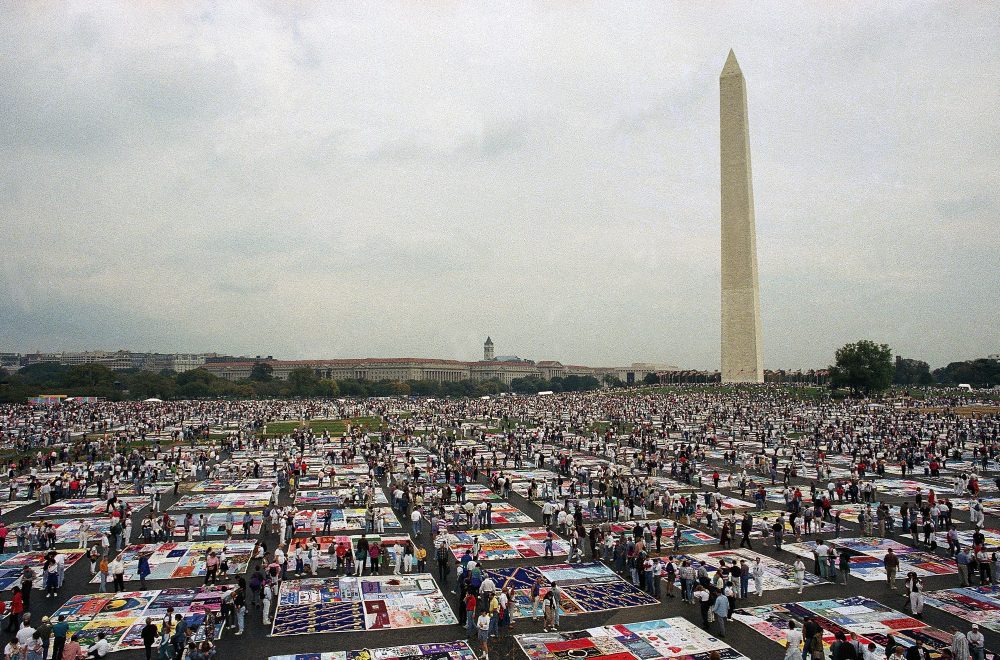
The quilt first appeared publicly on the National Mall in Washington in 1987, six years after AIDS was formally identified. At that point it included nearly 2,000 panels and stretched beyond the length of a football field. People walked through it quietly, many rendered speechless by what they saw.
The mid-1980s were a time of large-scale collective action — “We Are the World,” Hands Across America, “Do They Know It’s Christmas?”, Farm Aid, and a wave of benefit concerts. The quilt offered a quieter but equally powerful statement.
Its last full display on the National Mall came in 1996. According to the Smithsonian, the quilt stretched an entire mile — from the Capitol building to the Washington Monument — across a lawn that has witnessed generations of American activism. At that time, the quilt held 40,000 panels. Today, that number has grown to nearly 50,000.
The National AIDS Memorial continues to encourage people to create new panels. The effort is also a reminder of an unfinished fight: there is still no cure for AIDS, and recent reductions in U.S. foreign aid have raised new fears about the return of AIDS wards in vulnerable regions such as southern Africa.